 |
|
Sources of Information About Pioneer Doctors
Introduction
Until the first Australian medical graduates entered the
profession in the 1860s, all Australian doctors were educated
and obtained their qualifications overseas. In the early colonial
period, the vast majority of Australian doctors were emigrants
from the United Kingdom. When the gold rushes started, this
trend continued, although a few additional doctors emigrated
from America, New Zealand, India, and Europe. In the middle
colonial period, some doctors who were born here, or had immigrated
as children, went to study at medical schools in the United
Kingdom, returning to Australia to practice. In the later
colonial period most new doctors were Australians who were
trained in Melbourne or Sydney.
The
doctor in society
In early Australia, doctors often held official posts as
medical officers on emigrant ships and convict transports,
in the army or navy, and in the colonial public service. In
these positions, and in the small towns and cities of early
Australia, the doctor was more prominent than many of his
fellow citizens, and was much more likely than most to have
left some record of his professional and personal existence,
either in official documents, or in medical publications and
newspapers.
Thus the doctor was a trusted and well-known figure. He was
often sought to serve on committees. He was frequently a central
figure in establishing and running his local church or private
school. He often became involved in key businesses, such as
banks, newspapers, railways, and shipping. In addition to
the variety of official posts open to him, he sometimes entered
politics, or ran for the local council: it is common to find
early doctors who became mayors, or members of parliament.
Many doctors became pastoralists and prominent landowners.
Records
of doctors on ships
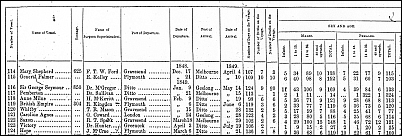
When looking for official
records of doctors, a natural place to start is with the very
important records of doctors on ships. Everyone who came here
in the early days came, of course, by ship - and almost every
ship carried at least one doctor. These included naval vessels,
convict ships, and the vast number of passenger ships which
brought immigrants to Australia.
Doctors on convict ships
The ships of First Fleet and later naval and convict ships
carried doctors as medical officers. Often these medical officers
kept a journal, whether for private or official purposes.
There were 10 medical officers on the 11 ships of the First
Fleet, under the direction of Surgeon General John White.
John
White's journal is now one of the most treasured of the
First Fleet documents. A doctor came out as surgeon on nearly
every convict ship throughout the period of transportation
of convicts to Australia, which lasted until 1868, and involved
something in the order of 1,600 voyages. About 350 surgeons
are mentioned by name in Charles Bateson's legendary book
on the Convict Ships. Many made more than one voyage.
Convict doctors
Some doctors came as prisoners in convict ships, but they
were few and far between. There were in total about 160,000
people transported to the Australian colonies as convicts.
According to David Richards, who published most of what is
now known of this topic, about 112 were of these doctors.
Ships' surgeons
About 750,000 people emigrated to Australia in the period
from settlement to 1860. The average ship carried between
200 and 300 immigrants, which means there were roughly 3,000
voyages to Australia by immigrant ships in this period. In
broad terms, every passenger or immigrant vessel of any size
carried a medical officer,
known as the Surgeon or Surgeon Superintendent. While it is
true that many doctors emigrated as passengers, and one early
doctor chartered a whole ship to bring his family out to Australia,
it was a more common practice to sign up as a Surgeon Superintendent
with an immigrant ship and so work the passage out. Some doctors
made two or more voyages to Australia as ships' medical officers
before
settling here themselves. Some made numerous voyages in this
capacity, and never settled here. In the official lists of the
voyages of immigrant ships, the name of the surgeon superintendent
is nearly always recorded alongside that of the captain, so
these voyages can easily be traced.
Doctors who came out as passengers may be found on passenger
lists, often with Dr in place of the usual first name on the
list.
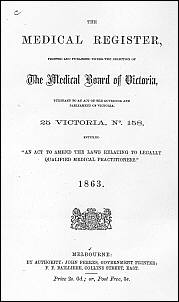
Medical registers
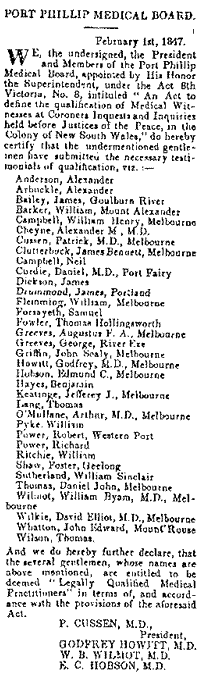
Medical registration began in NSW in 1838, and was extended
to the Port Phillip district in 1844. The medical register
was an official list of legally qualified medical practitioners
(although army and navy surgeons, who were not always qualified,
could also register). Initially registration was voluntary,
but the legislation was steadily tightened up, until unregistered
medical practice was effectively illegal. This does not mean
that every doctor was registered. The exceptions were:
- first, those who had given up the practice of their profession
due to illness or infirmity, or to the acquisition of a
large inheritance or another career;
- secondly, those who were unqualified;
- thirdly, those who had a qualification which did not count
for the purposes of registration;
- fourthly, those who were too lazy or too proud to register;
and
- lastly, those who were in prison, or in the army or the
navy.
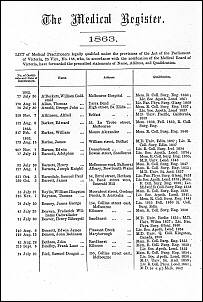
Medical registers
vary somewhat in the information they contain. The early medical
registers give only the doctor's name and place of residence.
Later registers, however, are more informative. They usually
give the doctor's full name and address, his qualifications,
including the years in which they were acquired, and date
when he first registered. The latter can be useful, but may
be misleading. For example, the later registers for Victoria,
due to new arrangements which came into force in 1862, always
listed doctors who had been registered before 1862 as having
been first registered in that year. It should be noted that
registers are not always in strict alphabetical order, and
there can be misspellings of names. Often, unfortunately,
the spelling mistake is in the first letter of the surname
(thus for example Frederick William Towle of Geelong is listed
on early registers as Frederick William Fowle).
 |
 |
Where the medical registers list qualifications,they are
either licences, awarded after an apprenticeship by a medical
or surgical guild, or degrees, awarded by a university.
In either case the date and place of the qualification is
generally indicated in the register. This can be a valuable
clue to further research. The original licensing bodies or
universities can be contacted for further information. Licensing
bodies are usually a Society of Apothecaries, a College of
Surgeons or a College of Physicians, in a particular city.
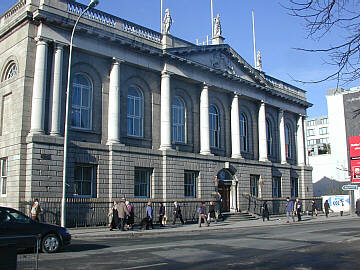
Pictured here are buildings still occupied by the Society
of Apothecaries in London and the Royal College of Surgeons
in Dublin, which would have been familiar to many colonial
doctors..
Hospital
records
Doctors in the early days in Australia often sought hospital
appointments. Some were resident surgeons, others were consultants.
Very often therefore, traces of a doctor may be found in hospital
records of appointment, whether to the salaried or the honorary
staff, and in the minutes of hospital committees of management.
A considerable amount of information about individual doctors
is often to be found in published hospital histories.
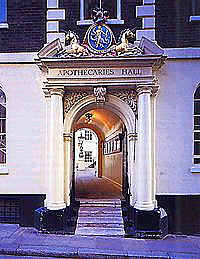
By kind permission of The Worshipful Society of Apothecaries
of London |
Other
official records
What other official records are pertinent to doctors? Doctors
of course signed death certificates. Once uniform system of
recording deaths was introduced, doctors can be traced through
entries in
death registers. Doctors also often had to appear in court to testify at trials,
particularly the more serious ones, such as murder trials, records
of which would also appear in the press. Doctors were often
called upon to advise governments on public health issues, and
they frequently appeared on government committees of inquiry.
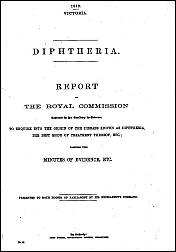
Numerous doctors, for example, were members of, or testified
before, the Diphtheria Commission of 1872.
The colonial governments also appointed Health Officers. Coroners were always
doctors, until the two roles were separated in the latter
part of the century. Doctors occupied official posts in various
types of government institutions, particularly in gaols, hospitals,
benevolent asylums, lunatic asylums, and children's homes
or industrial schools, as well as on government ships, and
in the army and navy reserve units. Doctors were appointed
as public vaccinators. They were also appointed as quarantine
officers. In all these official capacities their appointments
were announced in the government gazette, and very often echoed
in the local paper, and the medical journals.
Professional advertisements
Assuming a doctor to have self-employed, as would typically
be the case with a general practitioner, other records of
his professional life (aside from any minor government appointment
used to supplement his income) could be hard to find. However
most general practitioners advertised at some stage in their
career.
It was in fact considered unethical for a doctor
to advertise in the normal course of events, but upon arrival
in a new town, or when resuming practice after an absence,
or when moving from one house to another, the accepted procedure
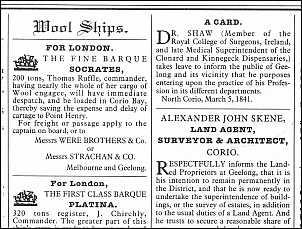
was to place a small advertisement, sometimes known as a 'card',
in the local paper. Such advertisements often carry useful
information, such as the doctor's new and old addresses, his
specialties, his fees, his consulting hours, his partners,
his previous positions, and his qualifications.
Trade
directories and related publications
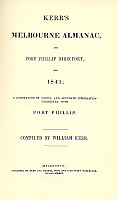
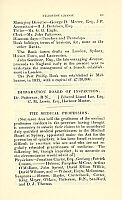
Contemporary directories, such as trade directories and biographical
dictionaries, can also be useful. In later Victorian times
doctors are mentioned in publications such as "Men
of the Time" or the Cyclopaedia
of Victoria.
Professional Publications
Many colonial doctors wrote books or journal articles for
publication on medical topics. These are often useful sources
of personal information. The title page of a book usually
gives the writer's qualifications, and sometimes includes
his present position, his previous positions, and his previous
publications. The preface often mentions his address. Journal
articles are not so abundant in personal information, but
often give the writer's address.
Medical publications of the eighteenth and nineteenth centuries are,
however, not easy to find. The Internet can be used to consult library
catalogues, particularly those of the National Library of Australia and
the British Library. But journal articles do not generally appear in library
catalogues. They are found mainly by consulting printed bibliographies
(see below), or by looking through the printed indexes in the bound volumes
of the journals themselves.
 |
Because journal articles are quicker and easier to write
than books, a doctor is more likely to have written an article
or a letter to the editor than a book. It is worth looking
for journal articles anytime after about 1830. Often a doctor
might write up an interesting case he had treated, or write
to the editor expressing an opinion. Doctors in Australia
received medical journals from England, and so they often
wrote for those journals. The most important English journals
for the Australian medical historian are the Lancet
and the BMJ. To these must be
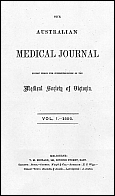
added the Australian Medical Journal,
which commenced life in 1856. All these publications, including
the English ones, are available in the university medical
libraries and the state libraries.
Membership
records of professional societies
In Australia the most important of these were the Medical
Society of Victoria, and the British Medical Association.
Meetings of the MSV were reported in the society's journal,
the Australian Medical Journal.
Records of community
groups
Doctors often appeared on committees, partly perhaps because
their professional lives were led in relative isolation from
other professionals, so the committee was a source of fellowship,
and partly because of their strong sense of social responsibility.
Thus doctors are often to be found on school councils, church
committees, and the committees of football clubs, mechanics
institutes and so on. If the minutes or correspondence of
those committees still exist, they will contain further useful
information, and more might be found in reports published
in newspapers of the relevant organisation's activities.
The
Local paper
Doctors were often writers of "letters to the editor",
sometimes on health matters, sometimes on social issues, often
on matters pertaining to local medical and hospital politics.
Any serious misconduct on the part of a doctor would certainly
be reported in some detail, particularly if he was drunk while
attending a woman in childbirth, or made overtures to an attractive
female patient, or negligently caused the death of a child.
If he was insolvent, that would be reported, as would his
imprisonment, should that occur. His new house, his marriage,
and the births of his children were always reported, as were
his trips "home". His death was invariably marked
by obituaries in the local paper, and in the medical journals.
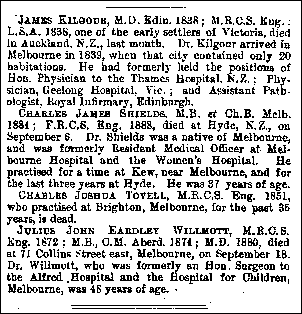
Obituaries
These can be a rich source of information about doctors whose
lives are otherwise obscure. As mentioned above, they usually
appear in the local press and in the Australian medical journals.
Throughout the colonial period, however, obituaries for Australian
doctors may also be found in the British newspapers and medical
journals.
The interesting examples shown below all come from one issue
of the Australasian Medical Gazette
(1897)
Overseas
Sources
As mentioned earlier, most early Australian doctors, up till
the first Australian medical graduates began to appear in
force in the 1860s, and the majority for some time afterwards,
grew up and were educated in Britain. As a result, there will
be records pertaining your medical ancestor's life in the
UK. Many such records are relatively inaccessible to us in
Australia. However the librarians at some of the medical schools
and colleges, such as the Royal College of Physicians, can
be helpful in looking up standard sources. These include the
English medical directories, which began in 1845 but are patchy
when it comes to individual doctors, and the medical registers.
Further information may be obtained from licensing bodies,
such as the Royal College
of Physicians , and from educational institutions, particularly
the universities in Scotland, which produced most medical
graduates in the colonial period. Another major source of
information about doctors in Britain is army and navy records.
For further pointers in this complex area, see:
Was
your ancestor a doctor? by Alex Glendinning,
Records of the medical professions, by Susan Bourne and Andrew
Chicken (available from the Society of Genealogists); and
for Irish doctors, Tracing Medical Ancestors from the Royal
College of Surgeons in Ireland.
Secondary
sources
Local histories are always helpful
with doctors.
Hospital histories are always a
goldmine of information about doctors.
History books and articles can
also be useful. Numerous ships' doctors are mentioned by Michael
Canon in his book Perilous Voyages to
the New Land (1997).
Bibliographies are useful for journal
articles (the commonest form of publication by doctors), conference
papers (the second commonest, but not so well preserved) and
books. The two national medical bibliographies pertaining
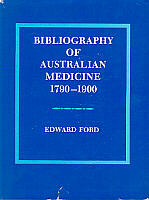
to Australia are Sir Edward Ford's Bibliography
of Australian Medicine (Sydney : SUP, 1976), and the
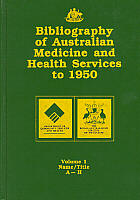
monumental Bibliography of Australian
Medicine and Health Services to 1950 (Canberra : AGPS
1988), which partly supersedes it.
Standard general reference works
such as the Australian Dictionary of
Biography, are useful for information about more prominent
doctors.
|
AMPI Bibliography
AMPI contains over 6,500 references to many hundreds of information
sources, not all of which are of equal interest. The bibliography
has been compiled by the present editor with a view to providing
a useful list of published works which are referred to reasonably
frequently in the AMPI records.
The bibliography includes published works cited on the original
AMPI index cards, along with some additional works cited in references
supplied by the present editor. However it is neither a complete
list of sources of information about early Australian doctors, nor
a complete list of sources used by the compiler. To avoid misunderstanding,
please read the following notes on the scope of the bibliography!
What is not included in the bibliography?
Because only published works are included, there are some important
unpublished sources which do not appear in the bibliography. These
include, for example, a number of lists of university graduates
and college members which David Richards obtained from universities
and medical colleges in Britain.
There are also many published works about early Australian doctors
which do not appear in the bibliography, because the compiler did
not use them, or at least did not often record references to them.
This applies to many hospital histories, for example, and to some
bibliographical sources, such as the Annotated Bibliography of
the History of Medicine and Health in Australia by Bryan Gandevia
and others (Sydney, RACP, 1984).
The bibliography also omits publications of limited interest, such
as the many local histories which appear only once or twice in the
references of AMPI records. In addition, serial publications as
such are not listed (although numerous individual articles from
periodicals are cited in the references).
Some kinds of published references, such as shipping lists, and
state government gazettes, have been extensively used in compiling
the records, but are rarely (if ever) cited in the references, and
so are not listed here. Finally, the present editor has been unable
to identify some of the references cited by David Richards, and
these are necessarily omitted from the bibliography.
What is included in the bibliography?
The bibliography includes
(or aims to include) all the major published references cited in
the AMPI records. Many of these, such as the medical directories
and the medical registers, contain only information about doctors.
Others, such as the Australian Dictionary of Biography, are
obviously not limited to doctors.
Please note that, in this context, major reference
works are not necessarily large publications. Rather, they are those
which are frequently referred to because they contain key information.
Thus, for example, Hopton’s short article listing medical practitioners
at Port Phillip between 1835 and 1851 is a major reference work.
|
Medical references (apart from medical
directories and registers)
|
| |
University of Melbourne Medical School Jubilee 1914.
|
Melbourne : Ford, 1914
|
|
Bostock J.
|
Dawn of Australian psychiatry
|
Sydney : Australasian Medical Publishing Company, 1968
|
|
Bowden K. M.
|
Doctors and diggers on the Mount Alexander goldfields.
|
Maryborough, Vic : the author, 1974
|
|
Bowden K. M.
|
Goldrush doctors at Ballarat.
|
Balwyn, Vic : the author, 1977
|
|
Bray F. I.
|
Some early medical men of Western Australia.
|
Medical Journal of Australia 1935; i: 793-801
|
|
Bridges B.
|
Beginnings of medical care for aborigines in Eastern Australia
(NSW)
|
Medical Journal of Australia 1970; ii: 881-3
|
|
Bridges-Webb C.
|
Some early medical history in Gippsland. In: Australia's
quest for colonial health, edited by John Pearn and Catherine
O'Carrigan.
|
Brisbane : Department of Child Health, Royal Children's Hospital,
1983:191-201
|
|
Brown K. M.
|
Medical practice in old Parramatta
|
Sydney : Angus & Robertson, 1937
|
|
Brownhill W. R.
|
Guardians of health. In: History of Geelong and Corio Bay.
Postscript edition.
|
Geelong : Geelong Advertiser, 1990
|
|
Bruck L.
|
Australasian medical directory and handbook
|
Sydney [various dates from 1883]
|
|
Bruck L.
|
Guide to the health resorts in Australia, Tasmania, and New
Zealand,
|
Sydney : Australasian Medical Gazette, 1883
|
|
Cleland J. B.
|
Pioneer medical men in South Australia
|
Adelaide : Pioneers' Association of South Australia, [1941?].
|
|
Cleland J. B.
|
First fifty-two names in the medical register of South Australia
|
Medical Journal of Australia 1938; ii: 732-8
|
|
Cobcroft M.
|
Medical aspects of the Second Fleet. In: Pearn J, O'Carrigan
C. Australia's quest for colonial health
|
Brisbane : Department of Child Health, Royal Children's Hospital,
1983: 13-33
|
|
Cohen B. C.
|
History of medicine in Western Australia.
|
Perth : Paterson Brokensha, 1965
|
|
Crowther W. E.
|
Practice and personalities at Hobart Town 1828-1832
|
Medical Journal of Australia 1954;i:421-30
|
|
Crowther W. E.
|
Changing scene in medicine: Van Diemen's Land 1803 to 1853
|
Medical Journal of Australia 1941;ii:29-34
|
|
Crowther W. E.
|
An address on some aspects of medical practice in Van Diemen's
Land, 1825-1839.
|
Medical Journal of Australia 1935;i:511-9
|
|
Crowther W. E.
|
Coming of medicine to Tasmania
|
Medical Journal of Australia 1938;i:340-3
|
|
Cummins C. J.
|
Colonial medical service. Parts I and II.
|
Modern Medicine of Australia. 1974;17(1,2):11-24, 11-25
|
|
Dan N
|
Medical men of the First Fleet. In: Pearn J., O'Carrigan
C. Australia's quest for colonial health.
|
Brisbane : Department of Child Health, Royal Children's Hospital,
1983: 3-12
|
|
Dunlop N. J.
|
Peep into the past : early Australian surgery. Parts I and
II
|
Medical Journal of Australia 1924;ii:471-6, 522-8
|
|
Ford E.
|
Bibliography of Australian medicine 1790-1900.
|
Sydney : Sydney University Press, 1976
|
|
Ford E.
|
Medical practice in early Sydney.
|
Medical Journal of Australia 1955;ii:41-54
|
|
Ford E.
|
Some early Australian medical publications.
|
Medical History 1972 Jul;16(3):205-25
|
|
Fulton R. V.
|
Medical practice in Otago and Southland in the early days
|
Dunedin, N.Z. :Otago Daily Times and Witness Newspapers,
1922
|
|
“Garryowen”
|
Disciples of Aesculapius. In his: Chronicles of early Melbourne
1835 to 1852.
|
Melbourne : Ferguson and Mitchell, 1888
|
|
Gordon D.
|
Ballow and the "Emigrant" Incident.
|
Medical Journal of Australia 1966; i: 483-5
|
|
Gordon D.
|
Men of medicine at Separation.
|
Medical Journal of Australia 1962;ii:1-10
|
|
Gordon D.
|
Waiting years : 1842 to 1859
|
Medical Journal of Australia 1966; i: 288-90
|
|
Graham H. B.
|
Happenings of the now long past : the centenary of the Medical
Society of Victoria.
|
Medical Journal of Australia 1952;ii:213-47
|
|
Graham H. B.
|
Honourable David Elliot Wilkie M.D. : a pioneer of Melbourne.
|
Medical Journal of Australia 1956;i:557-65
|
|
Haines E.
|
Pharmacy in Australia.
|
Sydney : Australian Pharmaceutical Publishing Co, 1988
|
|
Hopton A. J.
|
List of registered and unregistered medical practitioners
at Port Phillip between 1835 and 1851.
|
Journal of the Royal Australian Historical Society 1950;36:376-9
|
|
Howard G. T.
|
Port Phillip's early doctors 1835-1839.
|
Medical Journal of Australia 1934; i: 361-6
|
|
Hughes J. E.
|
History of the Royal Adelaide hospital 2nd ed.
|
Adelaide : the Hospital, 1982
|
|
Jackson S. E.
|
Historical notes from the records in the Brisbane Hospital,
1825-1850
|
Medical Journal of Australia 1922; i: 685-94
|
|
Kennedy R. T.
|
Earliest Gundagai medical practitioners.
|
Journal of the Royal Australian Historical Society 1947;
33 (Pt.3): 145
|
|
Lake M.
|
Vine and scalpel.
|
Brisbane : Jacaranda Press, 1967
|
|
Mackay E. A.
|
Medical men as pastoral pioneers.
|
Medical Journal of Australia 1934;ii:476-84
|
|
Mackay E. A.
|
Medical practice during the goldfields era in Victoria.
|
Medical Journal of Australia 1936;ii:421-8
|
|
McIntosh A. M.
|
Case of Dr. James Mitchell.
|
Medical Journal of Australia 1956 ii 161-8
|
|
McWhinney A.
|
History of pharmacy in Western Australia.
|
Perth 1975
|
|
Mitchell A. M.
|
Hospital south of the Yarra : a history of Alfred Hospital.
|
Melbourne : the hospital, 1977
|
|
O'Sullivan D. M.
|
David John Thomas : a founder of Victorian medicine
|
Medical Journal of Australia 1956; i: 1065-72
|
|
Patrick R.
|
Horsewhip the doctor : tales from our medical past.
|
St. Lucia, Qld : UQP, 1985
|
|
Pearn J.
|
Forced emigration, favourable outcomes.
|
Australian and New Zealand Journal of Public Health 2001;25(5):458-63
|
|
Pearn J.
|
Medicine and botany.
|
Brisbane : Amphion Press, 1990
|
|
Pearn J.
|
Surgeon-superintendents on convict ships.
|
Australian and New Zealand Journal of Surgery 1996;66:253-6
|
|
Pearn J and Cobcroft M
|
Fevers and frontiers
|
Brisbane : Amphion Press, 1990
|
|
Pensabene T. S.
|
Rise of the medical practitioner in Victoria.
|
Canberra : ANU Press, 1980
|
|
Power D.
|
Plarr's lives of the fellows of the Royal College of Surgeons
of England.
|
Bristol : Wright, 1930
|
|
Richards D.
|
Medical convicts to New South Wales and Van Diemen's Land
1788-1818.
|
Medical Journal of Australia 1994;161:73-7
|
|
Richards D.
|
Medical transportees to the Australian colonies 1788-1868.
In: Covacevich J. History, Heritage and Health
|
Sydney : Australian Society for the History of Medicine.,
1996.
|
|
Richards D.
|
Medium red with fresh fruity nose...doctors and viticulture
in 19th century Australia
|
Journal of the Royal Society of Medicine 1991;84:678-81
|
|
Richards D.
|
Transported to New South Wales : medical convicts 1788-1850.
|
British Medical Journal 1987;295:1609-12
|
|
Rimmer W. G.
|
Portrait of a hospital: the Royal Hobart.
|
Hobart: Royal Hobart Hospital 1981.
|
|
Russell K. F.
|
Melbourne Medical School 1862-1962.
|
Carlton, Vic : Melbourne University Press, 1977.
|
|
Young J.A et al (eds)
|
Centenary book of the University of Sydney Faculty of Medicine.
|
Sydney University Press, 1984.
|
|
Australian Medical Registers and Directories
|
| |
List of legally qualified medical practitioners
|
Port Phillip Government Gazette [various years]
|
| |
Medical directory for New South Wales and Queensland.
|
Sydney : Joseph Cook, 1860
|
|
Medical Board of Victoria.
|
List of legally qualified medical practitioners.
|
Australian Medical Journal 1857;2:236
|
|
Medical Board of Victoria.
|
Register of medical practitioners
|
Melbourne : Government Printer, [various years]
|
|
New South Wales Medical Board.
|
List of the legally qualified medical practitioners of the
colony of New South Wales.
|
Sydney : W. Baker, 1842
|
|
New South Wales Medical Board
|
Register of medical practitioners
|
Sydney : Government Printer, [various years]
|
|
British Medical Registers and Directories
|
| |
British Medical Directory for England and Wales
|
London : Lancet, 1853-
|
| |
Irish Medical Directory
|
Dublin : William Curry, 1843-1846
|
| |
London and provincial medical directory
|
London : Churchill 1847-69
|
| |
Medical directory
|
London : Churchill, 1870-
|
| |
Medical directory for Ireland
|
London : Churchill 1852-1860
|
| |
Medical directory for Scotland
|
London : Churchill 1852-1860
|
|
General References (non-medical directories,
indexes, etc)
|
| |
Australian biographical and genealogical record. Series 1(1788-1841),
series 2 (1842-1899)
|
Sydney : A.B.G.R. in association with the Society of Australian
Genealogists, 1985, 1992
|
| |
Australian dictionary of biography
|
Carlton : Melbourne University Press, 1966-1993
|
| |
British parliamentary papers : colonies : Australia : volume
3. 1816 - 1830.
|
Shannon : Irish University Press, 1968
|
| |
Convicts to Australia website
|
Perth : Dead Persons’ Society, n.d. http://www.convictcentral.
com/
|
| |
Cox and Co.'s Sydney Post Office directory.
|
Sydney : Cox, 1857
|
| |
Ford's Sydney commercial directory.
|
Sydney : Pascoe, 1851.
|
| |
Historical records of Australia.
|
Sydney : Library Committee of the Commonwealth Parliament
1914-1925; and Canberra : AGPS 1997-
|
| |
New South Wales calendar and General Post Office directory
|
Sydney : Stephens & Stokes,1832-1837
|
| |
Index to unassisted passengers 1826-1853
|
Sydney : Archives Office of New South Wales
|
| |
Port Phillip almanac and directory for 1847
|
Melbourne : Herald Office, 1847
|
| |
Return showing the names of ships chartered for the conveyance
of immigrants.....
|
Melbourne : Immigration Office 1852-1862
|
| |
Sands Kenny & Co's. Melbourne Directory for 1851
|
Melbourne 1851
|
| |
Ships to Australia 1837-9: return of the number of passengers,
and the mortality, in government emigrant ships, 1837, 1838,
and 1839.
|
Ships List website.
http://www.theshipslist.com
|
| |
Victoria inward passenger lists: immigration to Victoria
1852-1879.
|
Melbourne : Public Record Office, n.d. (website)
|
| |
Walch's Tasmanian almanac
|
Hobart. :J. Walch & Sons,1870-
|
|
Australian National Botanic Gardens
|
Biography : biographical notes on plant collectors and illustrators
relevant to Australian botany
|
Website at http://www.anbg.gov.au/
biography/index.html
|
|
Bateson C
|
Convict ships
|
Glasgow : Brown, Son & Ferguson, 1959
|
|
Baxter C. J.
|
General muster lists of New South Wales and Norfolk Island
|
Sydney : A.B.G.R., 1999
|
|
Billis R. V. and Kenyon A. S.
|
Pastoral pioneers of Port Phillip. 2nd ed.
|
Melbourne : Stockland Press, 1974
|
|
Cannon M.
|
Perilous voyages to the New Land.
|
Mornington, Vic : Today's Australia Publishing Co, 1997
|
|
Cockburn R
|
Pastoral pioneers of South Australia.
|
Blackwood SA : Lynton, 1974 (first published 1927).
|
|
Coffey H. W. and Morgan M. J.
|
Irish families in Australia and New Zealand 1788-1983
|
Revised Ed. S.Melb. 1983
|
|
Erickson R.
|
Bicentennial dictionary of Western Australians.
|
Nedlands, W.A. : University of Western Australia Press, 1987-8
|
|
Flynn M.
|
Second Fleet : Britain's grim convict armada of 1790.
|
Sydney : Library of Australian History, 1992
|
|
Gibbney H. J. and Smith A. G.
|
Biographical register 1788-1939 : notes from the name index
of the Australian dictionary of biography.
|
Canberra : Australian Dictionary of Biography, 1987
|
|
Guilford E.
|
Hunter Valley directory 1841.
|
Newcastle : Hunter Valley Publications, 1987
|
|
Hughes I. A.
|
Passengers to Port Phillip [from various ports, in several
volumes, 1838-51]
|
Northcote, Vic : the auhor, 1980-1982.
|
|
Hughes I. A.
|
Coastal passengers to Port Phillip.
|
Melbourne : the author, 1983-6
|
|
Kerr W.
|
Kerr's Melbourne almanac and Port Phillip directory for 1841,
1842
|
Melbourne: Kerr and Holmes, 1841, 1842
|
|
Kopitke E.
|
Emigrants from Hamburg to Australia, 1852.
|
Brisbane, Queensland Family History Society, c1996
|
|
Low F.
|
City of Sydney directory for 1844-5
|
Sydney 1844
|
|
Nicholson I. H.
|
Shipping arrivals and departures : Tasmania
|
Canberra : Roebuck,1983-1985
|
|
Nobbs R.
|
Norfolk Island and its first settlement 1788-1814.
|
Sydney : Library of Australian History, 1988
|
|
Sainty M. R. and Johnson K. A.
|
Index to births, marriages and funerals in the Sydney Morning
Herald, 1831-1853
|
Sydney : the compilers, 1972
|
|
Statton J.
|
Biographical index of South Australians 1836-1885.
|
Marden, S. A. : South Australian Genealogy and Heraldry Society,
1986
|
|
General References (published lists of
university graduates)
|
| |
Alumni Dublinenses : a register of....Trinity College
|
London : Williams and Norgate, 1924
|
|
Anderson P. J.
|
Fasti academiae Mariscallanae Aberdonensis : selections from
the records of the Marischal College and University 1593-1860.
|
Aberdeen : New Spalding Club, 1889-1898
|
|
University of Glasgow
|
Roll of the graduates of the University of Glasgow from 3lst
December, 1727 to 3lst December, l897 : with short biographical
notes, compiled by W. Innes Addison
|
Glasgow : the University, 1898
|
|